SYSTEMATIC THEOLOGY > ESCHATOLOGY > DISPENSATIONALISM (DISPENSATIONAL THEOLOGY)
What is Dispensational Theology?
“Dispensational Theology can be defined very simply as a system of theology which attempts to develop the Bible’s philosophy of history on the basis of the sovereign rule of God. It represents the whole of Scripture and history as being covered by several dispensations of God’s rule.”
━━ Dr. Renald Showers, There Really is a Difference, 27.
“Dispensationalism is a system of biblical interpretation that sees a distinction between God’s program for Israel and His dealings with the church.”
━━ John MacArthur, Faith Works, 219.
“When we talk about a dispensational theological system, we should understand this to mean the harmonization of biblical principles and events that are not isolated but seen as a collection of truths working together towards a single common goal that God has established for his glory. The system itself represents a tool that organizes these truths into a coherent systematic structural approach to the Scriptures, that can then be used to aid in better understanding God’s revealed revelation concerning his eschatological plans.”
━━ Reid A. Ashbaucher, Dispensational Theology: A Textbook on Eschatology in the Twenty-first Century.
What are the 7 Dispensations?
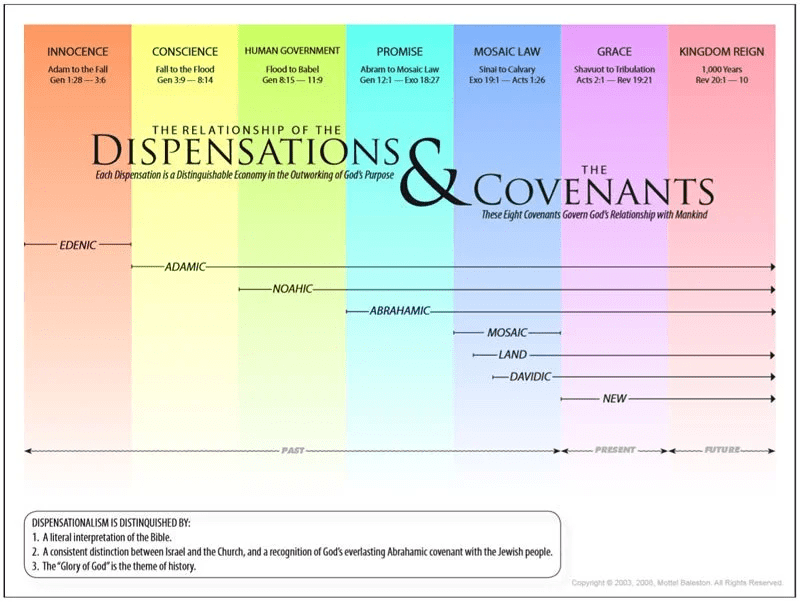
1 — Dispensation of Innocence (Gen 1:26-3:24)
Dispensation of Innocence. Man was created innocent in a perfect environment, provided a test given by God, but was disobedient resulting in judgment, curse and expulsion from the garden (Gen. 1:26-3:6).
2 — Dispensation of Conscience (Gen 4:1-8:19)
Dispensation of Conscience. Man disobeyed God’s command not to eat from the tree of the knowledge of good and evil (Gen. 2:17; 3:8). His disobedience resulted in sin and man’s eventual death. Man’s wickedness became so great, making it necessary for God to destroy all of humanity on earth, except for Noah and his family (Gen. 3:7-8:19).
3 — Dispensation of Human Government (Gen 8:20-11:32)
Dispensation of Human Government. God established the Noahic Covenant, wherein He inaugurated the judicial rule within the society of mankind in order to control the wickedness of man (Gen. 8:20-11:32).
4 — Dispensation of Promise (Gen 12-Exodus 18)
Dispensation of Promise. Begins with the Abrahamic Covenant made exclusively with the family of Abraham and nation of Israel (Gen. 12:1-Ex. 18:27).
5 — Dispensation of Mosaic Law (Exodus 19-Matthew 27:56)
Dispensation of Law. Instituted at Mount Sinai setting forth the Moral, Religious, and Civil laws to govern Israel under the Mosaic Covenant, and the Law of Moses as a way of life but was abrogated at Christ’s death and Resurrection (Ex. 19:1-Acts 1:26).
6 — Dispensation of Grace (Matthew 27:57-Rev 19:21)
Dispensation of Grace or Church Age. Begins after the Ascension of Christ on the Day of Pentecost with salvation of Jewish people and quickly spread throughout the Gentile world, and will be culminated with the Rapture of the church (Acts 2:1).
7 — Dispensation of the Millennium (Rev 20:1-6)
Dispensation of the Kingdom Age. Jesus Christ returns to earth at His Second Coming to setup the Millennial Kingdom on earth. It will include the conversion and restoration of Israel along with the ultimate fulfillment of the unconditional covenants made with the nation (Rev. 20:4).
What are the Key Beliefs?
“(1) belief that the Bible refers to multiple senses of terms like “Jew” and “seed of Abraham”; (2) an approach to hermeneutics that emphasizes that the Old Testament be taken on its own terms and not reinterpreted in light of the New Testament; (3) belief that Old Testament promises will be fulfilled with national Israel; (4) belief in a distinctive future for ethnic Israel; (5) belief that the church is a distinctive organism; and (6) a philosophy of history that emphasizes not just soteriology and spiritual issues but social, economic, and political issues as well.”
━━ John S. Feinberg, Systems of Discontinuity, in Continuity and Discontinuity: Perspectives on the Relationship Between the Old and New Testaments, ed. John S. Feinberg (Wheaton, IL: Crossway, 1988), 67–85.
Ian’s Notes
- 95 Thesis
- Amyraldians
- Antichrist
- Calvinistic Heritage
- Date Setting
- Davidic Throne
- Day of the Lord
- Dispensationalists (List)
- Domitian Dating
- Ezekiel (Did The Temple Not Happen?)
- Ezekiel (Literal Temple)
- Ezekiel (Temple Sacrifices)
- Ezekiel (Zerubbabel)
- Forged From the Reformation
- Francisco Riberia
- Fullness of the Gentiles
- Futurism (Early Church Fathers)
- Gentile Converts (OT)
- Gnosticism
- Heavenly Signs
- Imminency
- Impact
- Israel (God’s People)
- Israel (God’s Purpose)
- Israel (God’s Relationship)
- Israel (Post-Exilic Restoration)
- Israel (Restoration)
- Jesus’ Reign
- Kingdom (Abraham)
- Kingdom (At Hand)
- Kingdom (Creation)
- Kingdom (Israel)
- Kingdom (Moses)
- Kingdom (Offer)
- Kingdom
- LaHaye and Hagee
- Last Trumpet
- Margaret MacDonald
- Marriage Ceremony
- Multiple Means of Salvation?
- Mystery
- Neronic Dating
- New Creation Model
- Non-Symbolic Numbers
- Olive Tree vs. Grape Vine
- OT Saints (Baptism of the Spirit)
- Overview
- Reformed
- Repeated Prophecies (NT)
- Resurrection and Rapture
- Sacrifices (Purpose)
- Sermon on the Mount
- Terminology
- Three Judgments
- Two Covenant View
- Ultra and Hyper Dispensationalism
- Why I am a Dispy?
- YouTube Videos
- Zionism