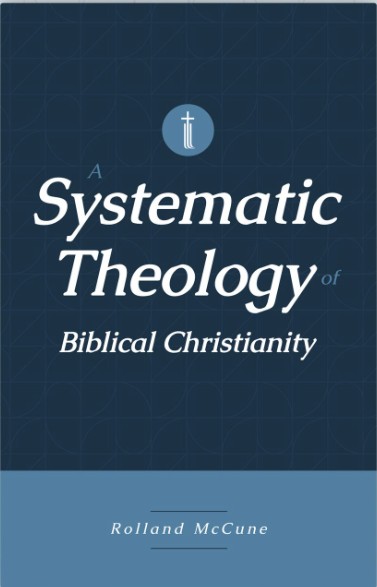
The Wait is Almost Over: Rolland McCune’s Systematic Theology (Coming Soon!)

Taken from: https://www.rbpstore.org/Products/Default.aspx?bookid=5702

A comprehensive systematic theology—written from within the dispensational Baptist framework.
For decades, Rolland McCune’s systematic theology served pastors, professors, and students seeking rigorous, Scripture-first doctrine rooted in the dispensational Baptist tradition. Now, for the first time, his complete three-volume work is available in a single, comprehensive volume—making it more accessible for classroom use and theological study.

About the Book
A Systematic Theology of Biblical Christianity presents the full scope of Christian doctrine—from prolegomena through eschatology—in a single volume of over 1,000 pages. McCune’s method is clear and consistent: Scripture alone is the source for theology. His work is carefully structured, well-documented, and written with both academic and ministry use in view.

Key Distinctives
Scripture as the sole source for theology
Presuppositional apologetics
Dispensational framework of progressive revelation
Pretribulational premillennialism
Calvinistic soteriology
Baptist ecclesiology

Why Consider This as a Course Text
Comprehensive treatment of all major loci of systematic theology
Consistent theological framework throughout
Accessible to students without sacrificing rigor
Suitable as a primary text or supplementary reference


Continue reading “The Wait is Almost Over: Rolland McCune’s Systematic Theology (Coming Soon!)”

Romans 9:1-13 – A Calvinistic Dispensational Defence

It is often argued that Calvinism and Dispensationalism are incompatible in passages such as Romans 9:1–13, and that only Calvinistic Covenant Theology can adequately account for Paul’s argument. I contend, however, that the real tension lies not between Calvinism and Dispensationalism, but between both Arminian Dispensationalism and Calvinistic Covenant Theology.

An Arminian view of conditional individual or corporate salvific election sits uneasily alongside a dispensational commitment to God’s unconditional election of Israel. Dispensationalism rightly affirms a twofold election grounded in God’s unilateral promises. For that reason, only Calvinistic Dispensationalism maintains internal consistency.

Why? Because Calvinistic Dispensationalists understand Romans 9 to uphold the unconditional covenant God established with Abraham and Israel, together with the unconditional blessings that flow from God’s sovereign election of individuals. By contrast, Covenant Theology typically maintains that Israel, as a distinct covenant people, has been set aside and that the promises have been transferred to the Church.

Arminian Dispensationalists affirm that Israel remains bound to an unconditional covenant and that the promises have not been given to the Church. Yet they inconsistently deny that the same passage teaches unconditional election at the individual level.

Calvinistic Dispensationalists, however, affirm both realities: Israel remains the recipient of God’s unconditional covenant promises, and God sovereignly and unilaterally chooses individuals for salvation.

The purpose of this document is to defend the coherence and validity of these claims.

An Analysis of Commonly Used Synergistic Proof Texts

It is my hope to provide commentary on some of the commonly used synergistic proof texts and provide answers as to how a Calvinist would address each of these texts. These texts have often been appealed to by synergists to attack the notion of God’s sovereignty in salvation or to attack the Calvinistic doctrine of Soteriology (TULIP). I pray this document provides an opportunity for engagement and sharpening!

The texts that are evaluated in the document are:

Matthew 23:37
John 1:12
John 3:16
John 12:32
Acts 7:51
Romans 11:32
Colossians 2:12
1 Timothy 2:1-6
1 Timothy 4:10
Titus 2:11
Hebrews 2:9
2 Peter 2:1
2 Peter 3:9
1 John 2:2

Continue reading “An Analysis of Commonly Used Synergistic Proof Texts”

The Seriousness of Apostasy – An Exegetical Analysis of Hebrews 6:4-6

It is my attempt here to shed some light on one of the most debated passages in scripture. As a Calvinist I have seen many of my brothers and sisters try to avoid the consequences of this passage to uphold the biblical doctrine of perseverance. With that said, they often minimize the seriousness of apostasy. It is my belief that the author of Hebrews narrows in on this serious topic to talk about those who have failed to grow in their walk and could potentially fall back into old practices. This isn’t a text that ought to be used to argue that believers can lose their salvation, nor does it undermine perseverance of the saints. Rather, it upholds the seriousness of actively remaining obedient to the Law of Christ.

Continue reading “The Seriousness of Apostasy – An Exegetical Analysis of Hebrews 6:4-6”

The Lord Is Not Slow About His Promise – An Exegetical Analysis of 2 Peter 3:1-9

2 Peter 3:9 has become a common proof text used by Arminians to attempt to demonstrate God’s desire to save everyone. They regard the argument to follow along these lines:

“God is not slow about his promise to save you, as some count slowness, but is patient toward you (unbelievers), not wishing that any of you (unbelievers) perish, but that all (unbelievers) come to repentance.”

Continue reading “The Lord Is Not Slow About His Promise – An Exegetical Analysis of 2 Peter 3:1-9”