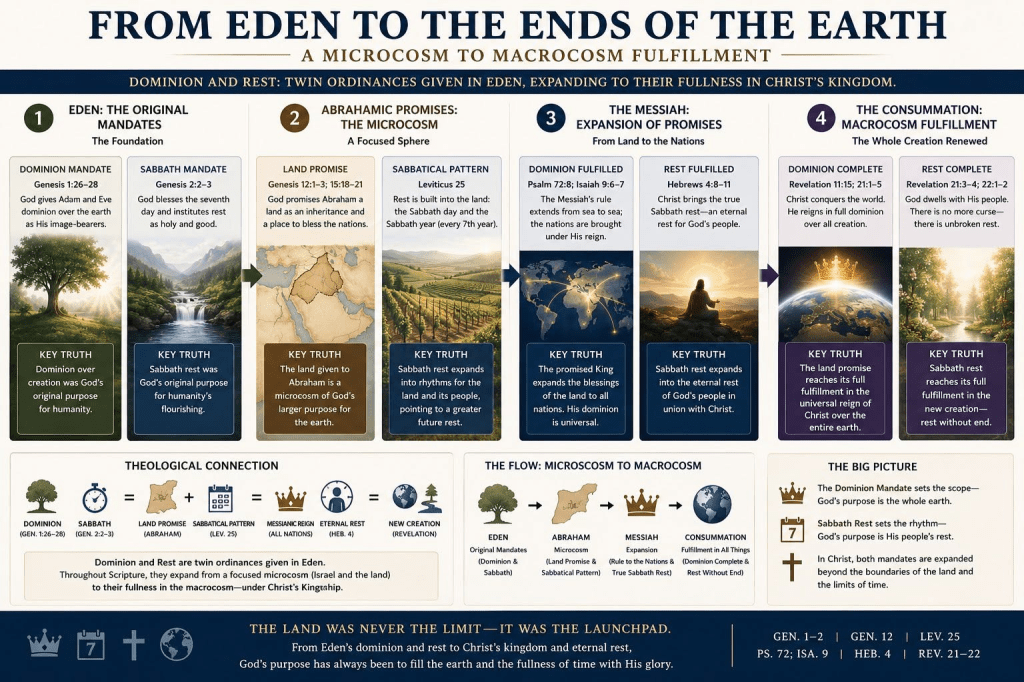
One area of biblical theology that I’ve been thinking more about lately is the relationship between the dominion mandate in Eden and the land promise given to Abraham. Brian Collins (Exegesis and Theology) has written a helpful series of posts interacting with Progressive Covenantalism, particularly on the themes of land and rest. While Collins critiques several of the specific proposals advanced by Progressive Covenantalist scholars—arguing that they require greater nuance (a concern I share)—he nevertheless acknowledges a genuine connection between the Abrahamic land promise and the Edenic dominion mandate.
In his post, Progressive Covenantalism and Land: Conclusion and Appeal, Collins writes:
“The central thesis of the Progressive Covenantalist view of the land, namely, that the land promise expands to encompass all of the new creation and all of the redeemed, is affirmed. This agreement rests on a shared belief that the material creation is significant in God’s redemptive plan. In addition, Progressive Covenantalists are correct in rooting the land theme in Eden. It is also correct to posit that the origins of this theme prior to the giving of the Abrahamic covenant point to a worldwide fulfillment of the theme in the new creation. Further, there is no disagreement with Progressive Covenantalists regarding the way the rest theme in Scripture points to the fulfilment of the land theme in the entire new creation.
These are points of genuine agreement, rather than concessions. My own thoughts on the land promise expanding to encompass the entire world developed in late 2010 and through 2011, prior to the publication of works by Progressive Covenantalists, as I worked through Scripture passages that speak of Israel possessing the nations and through a study on the theme of land in Joshua.”
I believe Brian is moving the discussion between Dispensationalists and Progressive Covenantalists in a helpful direction because he raises an important question: Can we affirm a broader biblical theology of the land without undermining the specific promises of the Abrahamic Covenant?
That question is especially significant for dispensationalists, I believe it deserves much more attention. Another way it could be asked is, can we preserve the integrity of the Abrahamic land promise—with its defined boundaries and covenantal certainty—while also recognizing that it serves within a broader creational purpose established in Eden?
My proposal is that we should not speak of the land promise itself as expanding what God covenanted to Abraham. Doing this risks redefining the covenant in ways I find unpersuasive and impermissible. It essentially undercuts authorial intent. Rather, I suggest that the language of expansion belongs more suitably to the fulfillment of the dominion mandate, not to the covenantal boundaries of the land—as Covenantalists and Progressive Covenantalists have proposed. In other words, the land remains exactly what God promised Abraham, but the Messiah who fulfills that promise of the land is also the Second Adam who fulfills the original mandate to exercise dominion over the whole earth.
Seen this way, the land of Canaan functions not as a type that is ultimately replaced by the world, but as the covenantal center from which God’s kingdom purposes extend to the nations and the fulfillment of the Abrahamic, Davidic, Priestly, and New Covenants. This seems consistent with the promise that “in you all the families of the earth shall be blessed” (Gen. 12:3), and that through the singular seed (Gen. 22:18) He will fulfill the requirements of both the dominion mandate and the land promise (Gen. 3:16). Christ will literally reign from the land promised to Abraham in fulfillment of the covenant, yet His reign will not stop at Israel’s borders. The prophets consistently portray the Messiah exercising dominion over all the earth, ruling the nations from Zion (cf. Isaiah 2:1-4, Zechariah 14). As a premillennialist, it seems natural to connect the fulfillment of the dominion mandate with the reign of Christ. Christ will fulfill the land promise by reigning over the land promised to Abraham in the millennial kingdom. Yet His reign is not limited to the boundaries outlined in the Pentateuch. He will also rule the entire earth, exercising universal dominion over the nations.
I’m also curious how the theme of Sabbath fits into this discussion. Is there a theological connection between Eden’s Sabbath, Israel’s Sabbaths and sabbatical years, the land itself, and the consummate rest brought by Christ? If dominion and rest are both rooted in creation, perhaps they develop together throughout redemptive history and climax in the millennial kingdom & the eternal state (new creation).
Additional questions for consideration:
1.) Is the land promise to Abraham connected in any meaningful way to Adam’s dominion mandate? If so, should we expect an expansion from the land to the whole earth?
2.) Can we say that Christ simultaneously fulfills both the Abrahamic land promise (by reigning over the promised land) and the dominion mandate (by reigning over the whole earth)?
3.) Is the microcosm-to-macrocosm framework a helpful way of describing the relationship between the land promise and Christ’s universal reign, or does it create unnecessary problems?
4.) Can we fully preserve the certainty and specificity of the Abrahamic Covenant while also recognizing that it may fit within God’s larger purpose of worldwide dominion?
5.) Is there a genuine theological thread connecting Eden’s Sabbath, Israel’s sabbatical laws, the land promise, and the Messiah’s premillennial reign?
6.) Is there something unique about Jerusalem/Zion that serves as a meeting point between the Abrahamic land promise and the fulfillment of the dominion mandate? Could this bring the Davidic Covenant and Abrahamic Covenants into more focus?