This critique will interact with Kenneth L. Gentry, Jr’s article called Definition where he outlines the basic structure of Postmillennial theology. This is by no means an exhaustive response to Postmillennialism, however it will address several concerns and areas of inconsistencies that I see surrounding his theology.
Luke 24:13-27 LSB And behold, two of them were going that same day to a village named Emmaus, which was sixty stadia from Jerusalem. 14 And they were conversing with each other about all these things which had happened. 15 And it happened that while they were conversing and debating, Jesus Himself approached and was going with them. 16 But their eyes were prevented from recognizing Him. 17 And He said to them, “What are these words that you are discussing with one another as you are walking?” And they stood still, looking sad. 18 And one of them, named Cleopas, answered and said to Him, “Are You the only one visiting Jerusalem and unaware of the things which have happened here in these days?” 19 And He said to them, “What things?” And they said to Him, “The things about Jesus the Nazarene, who was a mighty prophet in deed and word in the sight of God and all the people, 20 and how the chief priests and our rulers delivered Him to the sentence of death, and crucified Him. 21 But we were hoping that it was He who was going to redeem Israel. Indeed, besides all this, it is the third day since these things happened. 22 But also some women among us astounded us. When they were at the tomb early in the morning, 23 and not finding His body, they came, saying that they had also seen a vision of angels who said that He was alive. 24 Some of those who were with us went to the tomb and found it just exactly as the women also said, but Him they did not see.” 25 And He said to them, “O foolish ones and slow of heart to believe in all that the prophets have spoken! 26 Was it not necessary for the Christ to suffer these things and to enter into His glory?” 27 Then beginning with Moses and with all the prophets, He interpreted to them the things concerning Himself in all the Scriptures.
I was reading through J.V. Fesko’s work Death in Adam, Life in Christ and came across some interesting connections between the Covenant of Works/Adamic Covenant and its origins.
Fesko notes on pg. 72 that “…it appears that Roman Catholic theologians were some of the first to place Adam in covenant with God.”1 He attempts to tie the concept of an Adamic covenant back to Jerome through the Latin Vulgate translation of Hosea 6:7, which I find unconvincing2, and then through Augustine (though not exactly on comparable grounds), but it really finds its grounds in Ambrogio Catharinus who is a Roman Catholic priest.3
As I am becoming more and more aware of resources available responding to the preteristic understanding of Matthew 24:34 [ἡ γενεὰ αὕτη], I want to make them accessible here for those who are interested in knowing what resources exist.
I affirm that genea [γενεὰ] is used qualitatively in Matthew 24:34 to speak of a class/type of evil and wicked people which have existed from Abel to the time of Jesus [Matthew 23:35-36] and will continue until the Lord comes back (2nd Coming) and destroys “this” evil and wicked generation.
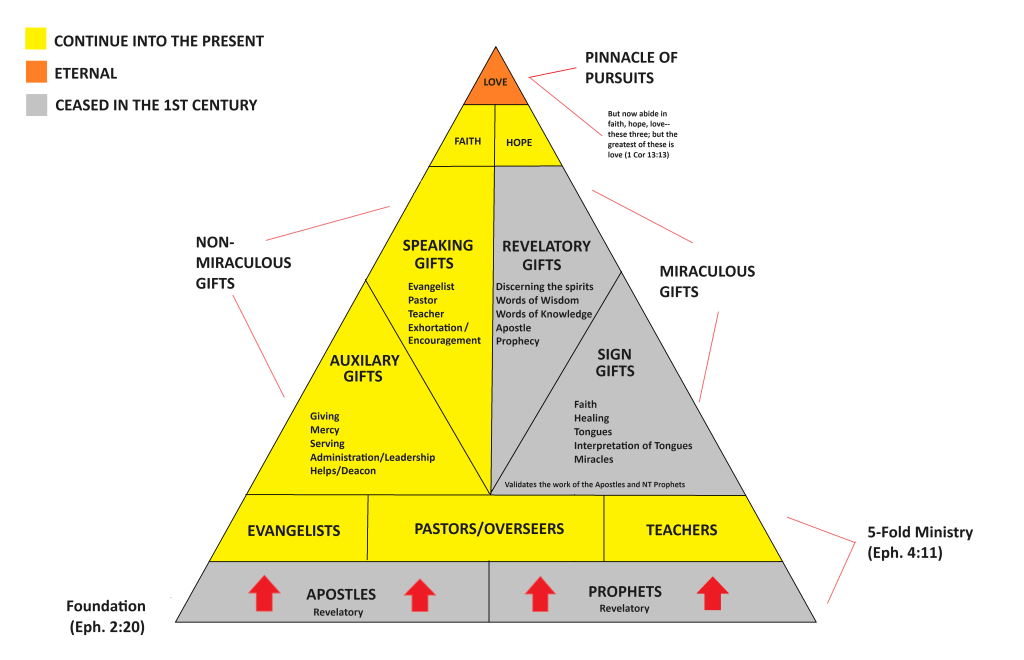
I spent a little bit of time over the summer working through a personal study on the spiritual gifts and I made a chart that I hope will be helpful to you as you work through this very important and controversial topic!
Fresh off the press, I have written a critique of congregationalism, or congregational polity, and local church membership. Before you assume the worst, please try to wrestle with my ideas and my contentions.
I am in no way implying that we should have no church polity, and I am in no way implying that I reject the local church and the importance of it in the life of the believer. Please don’t start with that assumption.
What I want to do is to show why (a) I don’t think congregationalism is the polity we should follow, whereas I adopt an Elder-Led/Rule model (think John MacArthur), (b) I don’t think we need to implement “local” church membership, since we are already members of the “universal” body of Christ. I believe this has created hurdles and problems in the local church that ultimately hurts non-members.
I expect some push-back and disagreement, but I think it is important for people to voice their thoughts about these two subjects, and since I am very much in-line with Reformed Baptist theology, I certainly want to share my thoughts in a respectful but critical way.
I hope that it will be a challenge to those of you affirm these two beliefs. I hope for those on the fence that you will consider my arguments and my reasoning and land somewhere perhaps where I have, and for those who are fresh to the subject, maybe it will give you something to think about when you enter into discussions with your leaders.
Lastly, a shout-out to my wife who is always supportive and who has been my talking partner for years around these subjects, may it make you proud.
Another day, another discussion with a Covenantalist. This time, I decided it would be worth recording down the conversation in Word, to show how the discussions tend to go with the Covenantalist.
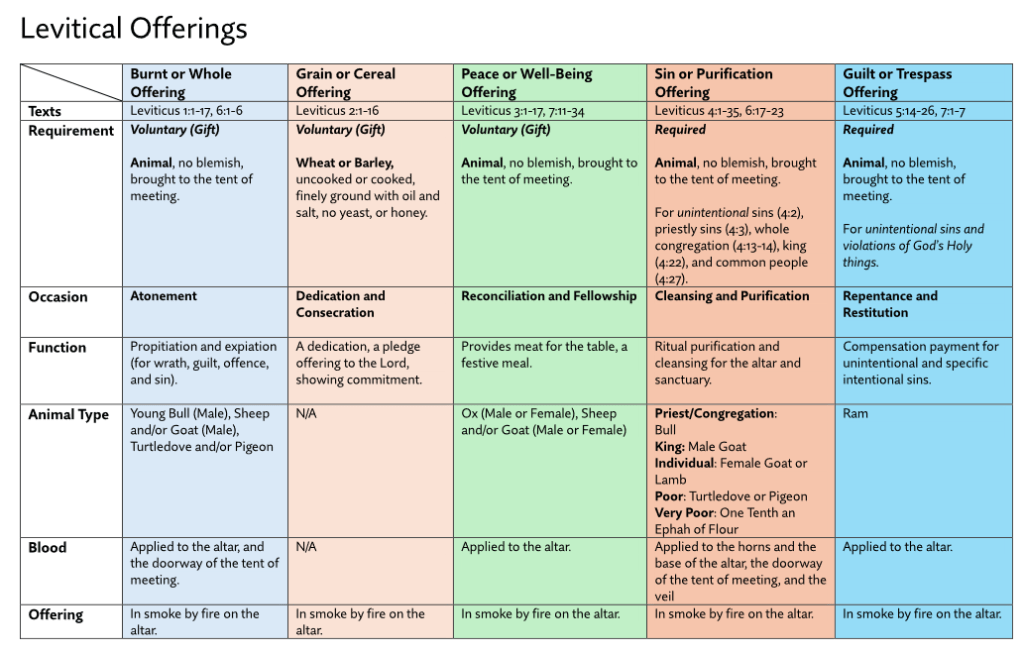
I was hoping to make a quick guide for those wanting to know more about the Levitical Offerings made in Leviticus 1-7. I have noticed a lot of confusion as it pertains to the topic, some has assumed that OT sacrifices serve no function, that they are simply shadows that look forward, but this undercuts the OT teaching of the occasion and function of these sacrifices. I hope to clarify some of this with the chart and quotations under the chart.
If there are any obvious concerns or errors with the chart, please let me know.
“Biblical interpretation is a discipline that all Christians perform, even if they do not realize it. Every time a person reads a work, whether this work is a newspaper, novel, or ingredient list, interpretation occurs. Interpretation is needed because words convey meaning when connected with other words. That means words form sentences, sentences form paragraphs, and paragraphs form chapters, which become books. Every author wrote those words, sentences, paragraphs, and books for a reason. Since each author wrote with a meaning attached to each word, sentence, and paragraph, it behooves readers to seek to understand what the author wrote.
Interpretation involves reading those words and discovering the author’s meaning without forcing a belief onto the text because no one wants their writings or sayings taken out of context. Therefore, interpretation becomes critical in everyday life. If interpretation becomes critical in everyday life, it seems that it would be just as critical, if not more critical, in the life of the Christian who strives to read and understand Scripture. The truth of this statement leads to the question this paper seeks to answer: What is the role and function of the original author’s intended meaning in communicating the Scripture’s message to a contemporary audience?