
Introduction – What is the Rapture?
1.) Defining the term Rapture
The word rapture comes from the Latin rapiemur, found in the Latin Vulgate’s translation of 1 Thessalonians 4:17. It translates the Greek verb harpazō (ἁρπάζω), meaning to seize, snatch, or catch away.
The term itself is not an extra-biblical invention, as some skeptics have attempted to argue.
Lee Brainard explains:
“It is commonly asserted that the word rapture doesn’t appear in the Bible, and this absence is held forth as evidence that the teaching of the rapture is a falsehood. But this claim is untrue. The word rapture does appear in the Bible. It appears in the exact same way that words like angel and apostle appear in the Bible. Τhe word rapture is simply the anglicized form of the Greek word ̔αρπαζω (harpazō) that appears in 1 Thessalonians 4:17 in the original text.
To begin with, the English word rapture is derived from the Latin participle raptus from the verb rapio. And Latin rapio and Greek ̔αρπαζω (harpazō) are cognates — they are the same word. Don’t be fooled by the superficial differences between Latin rapio and Greek harpazō. The -αζω (-azō) on the end of ̔αρπαζω (harpazō) is not part of the shared stem but a common Koine Greek verb ending. And the rough breather, the “h”, at the beginning, is not part of the shared stem either. The shared stem is simply “rap” — rap in Latin and ρ-π (r-p) in Greek.
The fact is, harpazō and rapio belong to a class of Greek and Latin cognates where Greek adds an “h” to the shared stem. Another example from this class is Greek ̔ιστημι (histēmi) and Latin sto. Here again, neither the “h” at the beginning nor the -μι (-mi) verb ending are part of the shared stem. The stem is stē in Greek and sto in Latin. And it is sta in English, from whence we get words like stand and standard.
So we see that English rapture, Latin rapio, and Greek harpazō are cognates — they are the same word in different languages. But not only are they the same word, they have the same meaning. Anyone who has done a little reading from extra-biblical Greek and Latin, or has at least enough familiarity with those languages to use the classical Greek and Latin lexicons, is well aware of the fact that Greek ̔αρπαζω (harpazō) and Latin rapio regularly bore the same sense of “remove from harm’s way” that pretribulationists claim for the English word rapture. It was regularly used by the mythologists of the gods snatching their favorites out of harm’s way. And it was regularly used in similar senses by the historical authors. I recently noted that Josephus used it of parents snatching their children up and running for cover when Titus sacked Jerusalem in 70 AD.
So the next time someone tries to educate you with the fictional-factoid that the word rapture doesn’t appear in the Bible, just smile and point out that the word rapture does appear in the Bible in the exact same way that words like angel, apostle, Messiah, Christ, Jesus, baptism, and apocalypse appear in the Bible. The English word rapture is the Greek word ̔αρπαζω (harpazō) in its anglicized form. And it would be just as legitimate to translate harpazō in 1 Thessalonians 4:17 by rapture as it is to translate αγγελος (aggelos) by angel. “Then we who are alive and remain shall be raptured together with them in the clouds to meet the Lord in the air.””1
2. Establishing the biblical description
The rapture or resurrection of the church saints is promised in two particular texts: 1 Thessalonians 4:16-17 & 1 Corinthians 15:51-52, which Paul describes as a mystery which was not revealed in the OT.
For the Lord Himself will descend from heaven with a shout, with the voice of the archangel and with the trumpet of God, and the dead in Christ will rise first. Then we who are alive and remain will be caught up together with them in the clouds to meet the Lord in the air, and so we shall always be with the Lord.
1 Thessalonians 4:16-17 (LSB)
Behold, I tell you a mystery: we will not all sleep, but we will all be changed, in a moment, in the twinkling of an eye, at the last trumpet. For the trumpet will sound, and the dead will be raised incorruptible, and we will be changed.
1 Corinthians 15:51-52 (LSB)
The event promises that Jesus Christ will descend from heaven, the dead in Christ will be resurrected, and living believers are transformed in the twinkling of an eye caught up to meet the Lord in the air to be with Him forever.
3. Establishing what the rapture is not
Terminology is frequently confused on this matter, so let’s establish what it is not:
- The rapture is not the Second Coming, the rapture is the first phase of the Lord’s return. The Second Coming is Christ’s descent to earth in judgment, as displayed in passages like Revelation 19:11-21.
- The rapture is not the resurrection of the martyrs or the resurrection of the OT saints. The resurrection of both of these groups occurs post-tribulational
- The rapture is not the Church escaping2 ordinary persecution or suffering.
4. Establishing the question of timing
Once we have defined what the rapture is, we have to ask ourselves, when will it happen? There are obviously disagreements as to when the rapture will occur3, and this will be based upon differences in the preliminary considerations.
Before attempting to establish the chronological placement of the rapture, several foundational biblical and theological considerations must first be addressed. We cannot properly determine when the Church is gathered to Christ without first understanding the nature and purpose of the period commonly referred to as “The Tribulation.”
In particular, we must establish the biblical distinction between Israel and the Church, the prophetic significance of Daniel’s seventieth week, the nature of the Day of the Lord, and the chronological framework provided by the prophetic Scriptures.
PART I – WHAT IS THE TRIBULATION?
This section is absolutely essential. Before determining when the Church is raptured, we must first determine what the Church is being raptured from.
A common weakness in discussions about the timing of the rapture is that people begin with the question, “When does the rapture happen?” without first establishing the nature and purpose of the period into which they are placing the Church. The question is not simply whether Christians will experience “tribulation“—since passages like John 16:33 and Acts 14:22 say they will4—the question is whether the Church is appointed to a particular eschatological divine judgment described in Daniel, Matthew, Thessalonians, and Revelation.
Some reject the terminology of “The Tribulation” but all that is meant by this term is Daniel’s 70th week contains tribulation (i.e., through the birth pangs) which gradually becomes more severe over the course of the 7 years. What starts as “birth pangs” moves increasingly toward more severe tribulation (i.e., the great tribulation).
1. Israel and the Church are Distinct Entities in God’s Prophetic Program
Before we can properly understand the Tribulation, we must establish the biblical distinction between Israel and the Church.
Israel is a nation descended from Jacob, to whom God made specific national, territorial, and covenantal promises. The Church, on the other hand, is the body of Christ, inaugurated at Pentecost, consisting of believing Jews and Gentiles united in Christ.5 This distinction does not mean that Jewish believers are excluded from the Church, nor does it mean that Gentile believers are somehow disconnected from the blessings of God’s redemptive purposes—as we see in Romans 11 and Ephesians 2-3. Rather, it recognizes that the incorporation of believing Jews and Gentiles into one body does not erase God’s particular promises—blessings or curses—to national Israel.
As soon as one attempts to make Israel and the Church interchangeable entities, the prophetic passages concerning Israel’s future judgment and restoration are distorted. When one holds that Israel and the Church are interchangeable they will likely veer towards post-tribulationalism. The more that one holds a distinction between the two entities they will likely veer towards pre-tribulationalism. This distinction is incredibly important to the debate, because it helps us to understand why the Church’s presence in the tribulation should not merely be assumed at the outset.
2. Daniel’s 70th Week Concerns God’s Purposes for Israel
You cannot begin to engage with the discussion of the timing of the rapture without understanding the debate surrounding Daniel 9:24-27.6 It is arguably one of the most important foundational passages for the entire discussion. Daniel 9:24-27 explicitly identifies the people and city in view. The people are Daniel’s people Israel, and the holy city is Jerusalem.
The six objectives of Daniel 9:24 concern the resolution of Israel’s transgression, sin, iniquity, and prophetic future. The prophecy is therefore not presented as a timetable for the Church, but as a divinely determined period concerning Israel and Jerusalem.
As a dispensationalist, I have argued that there is good reason to see a gap between the 69th-70th week.7 If we can agree that the 70th week of Daniel (i.e., Daniel 9:27) is future, we can move forward toward a discussion pertaining to when the rapture will occur in light of that conclusion.
3. The Day of the Lord: Establishing the Nature of the Coming Period
Before establishing the timing of the rapture, we must establish what Scripture means by the Day of the Lord (DoL).
Showers helpfully summarizes:
“In the Scriptures the expression “the Day of the Lord” (together with other synonymous expressions, such as “that day,” “the day of God,” etc.) is strongly related to God’s rule of the earth and, therefore, to His sovereign purpose for world history and specific events within that history. The Day of the Lord refers to God’s special interventions into the course of world events to judge His enemies, accomplish His purpose for history, and thereby demonstrate who He is the sovereign God of the universe (Isa. 2:10-22; Ezek. 13:5, 9, 14, 21, 23; 30:3, 8, 19, 25-26).”8
The DoL involves a two-fold pattern of judgment and restoration as several biblical scholars have noted9. Following Showers helpful work, he determines that there is a broad and a narrow understanding in scripture for the eschatological DoL. I won’t get into all the details regarding the DoL, because it is incredibly rich, but I implore you to research his material on the subject.
Two images I found helpful on this matter are seen below!
Image 110:
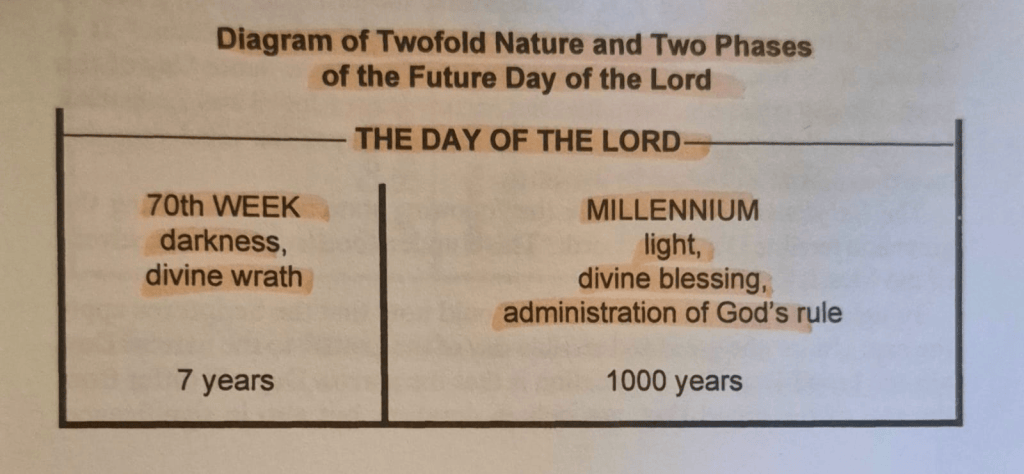
Image 211:
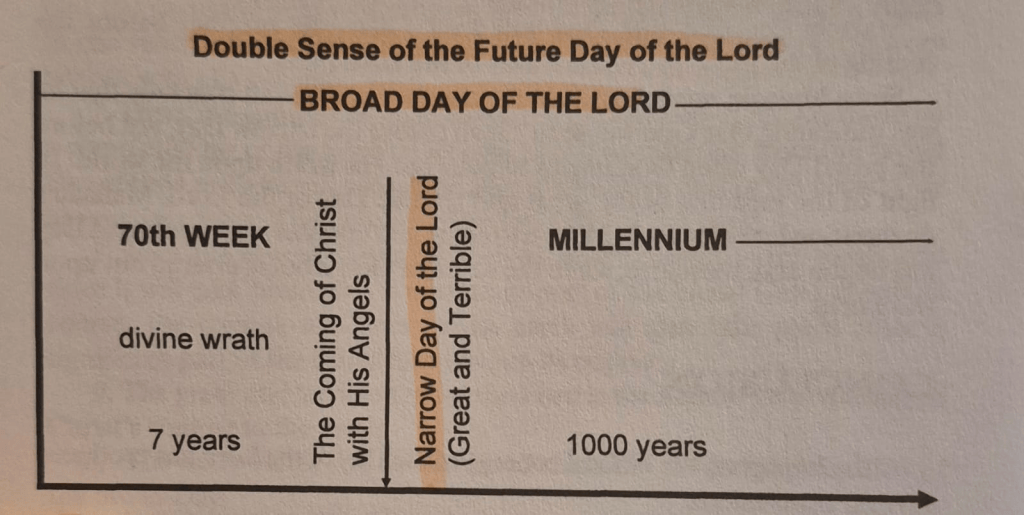
If Showers work is sound—which I believe it is based upon his study of both OT/NT—then we have an important structure surrounding when the DoL begins and ends.
4. The Prophetic Structure of the Tribulation
Having established the distinction between Israel and the Church, the nature of Daniel’s seventieth week, and the DoL, we can now examine the prophetic structure of this period. The scripture gives us identifiable chronological markers for the DoL:
a.) The first half of this tribulation or DoL begins with birth pangs. The beginning of birth pangs are seen in Matthew 24:4-14 and Revelation 6.
b.) The midpoint of the tribulation is marked by the Abomination of Desolation (AoD) seen in Daniel 9:27 and Matthew 24:15.
c.) The second half of the tribulation is marked by great tribulation seen in Matthew 24:21-22; Revelation 12-18.
d.) The climax is the narrow day of Christ’s divine judgment and Second Coming.
For my assessment of the Olivet Discourse, please see the following: https://abidingfoundations.com/2020/10/14/exegetical-analysis-matthew-241-51/
Conclusion of Part I:
We have now established that the Tribulation is not simply an unusually difficult period in human history. Rather, it is a distinct eschatological judgment, intended for Daniel’s people, associated with the 70th week. It is the Lord’s Day, and he will use it to bring Israel into judgment, to punish them such that the requirements of Daniel 9:27 might be fulfilled.
Now we can ask: What biblical reasons do we have to believe that the Church is gathered before this period begins?
PART II – THE POSITIVE BIBLICAL CASE FOR A PRE-TRIBULATIONAL RAPTURE
Now we move from establishing the nature of the Tribulation to demonstrating why the Church is not appointed to pass through it.
1. The Church is Promised Deliverance from the Coming Wrath
Paul tells the Thessalonians that they have turned from idols to serve the living God and to wait for His Son from heaven, Jesus, who delivers us from the coming wrath (1 Thessalonians 1:9-10). He will begin to develop the idea of the DoL in 1 Thessalonians 5 from which the Church will be delivered from.
For you yourselves know full well that the day of the Lord will come just like a thief in the night.
1 Thessalonians 5:2 (LSB)
The DoL will come just like a thief in the night. Unexpected. Quick. Without Notice.
While they are saying, “Peace and safety!” then destruction will come upon them suddenly like labor pains upon a woman who is pregnant, and they will never escape.
1 Thessalonians 5:3 (LSB)
Many will say “Peace and Safety” as though there is no looming judgment coming, and then, without notice, destruction will come upon them like labor pains—think back to birth pangs in Matthew 24. There will be no escape.
But you, brothers, are not in darkness, that the day would overtake you like a thief, for you are all sons of light and sons of day. We are not of night nor of darkness; so then let us not sleep as others do, but let us be awake and sober. For those who sleep, sleep at night, and those who get drunk, get drunk at night. But since we are of the day, let us be sober, having put on the breastplate of faith and love, and as a helmet, the hope of salvation.
1 Thessalonians 5:4-8 (LSB)
Contrasting day/night and darkness/light themes, Paul tells his audience to be awake, to be of the light, to not be asleep or drunk but to be sober.
For God has not appointed us for wrath, but for obtaining salvation through our Lord Jesus Christ,
1 Thessalonians 5:9 (LSB)
God has not appointed his bride for wrath, the wrath of the DoL. Which means, that there is no connection to the outpouring of wrath and the Church being appointed to such a day.
If the DoL includes the eschatological judgments described in Revelation—which would include the outpouring of the Lamb’s wrath in Revelation 6—and the Church is promised deliverance from that coming wrath, how is that promise fulfilled?
Revelation 3:10 also anticipates the protection from the hour of testing that will come upon the whole world.
‘Because you have kept the word of My perseverance, I also will keep you from the hour of testing, which is about to come upon the whole world, to test those who dwell on the earth.
Revelation 3:10 (LSB)
Christ does not say that he will preserve the Church through the trial, but he will remove them, or keep them from the trial.12
A question worth considering: What purpose would be served by appointing the Church to undergo the very period of divine wrath from which Christ promises to deliver her?
There is an important distinction between persecution by the world and judgment from God. The Church has and will continue to be subject to the former, but there is no good reason that the Church would need to be subject to the latter.
2. The Rapture and the Second Advent are Distinguishable Events
One of the most important arguments for the pretribulational position is that the New Testament describes two distinguishable aspects of Christ’s coming. When set side-by-side it becomes clear that the main passages in the discussion either fit the rapture of the church or the second advent but never both.
This image below will help to contrast the two phases of the Lord’s Second Coming.
Image 313:
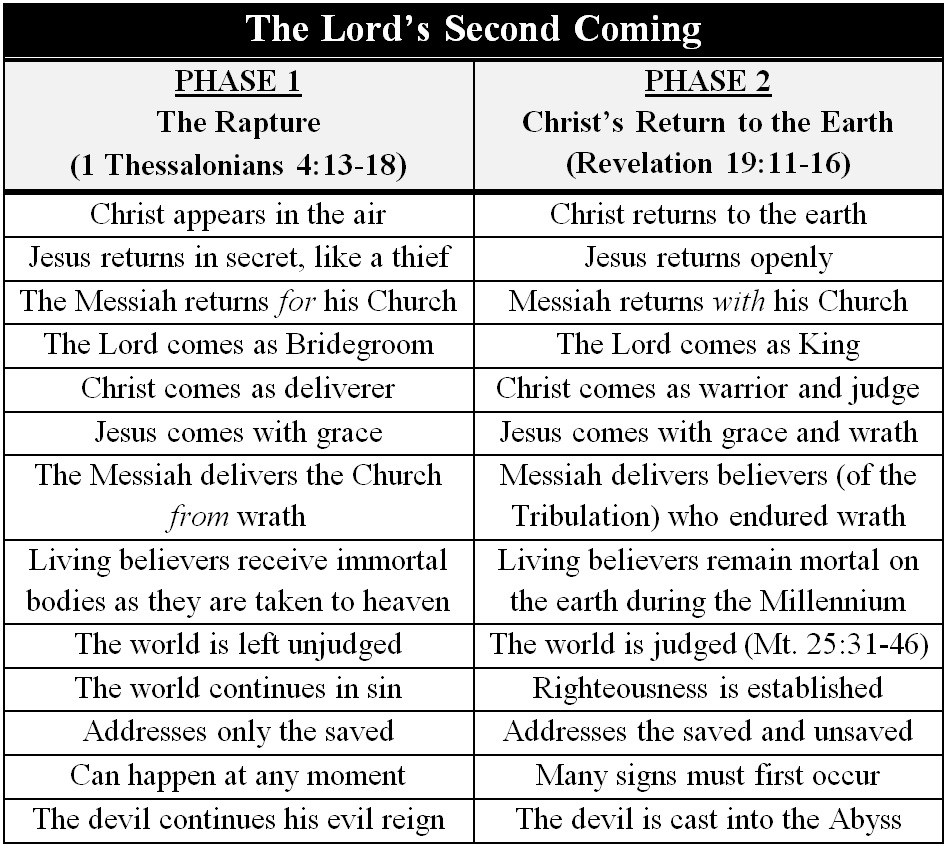
The first phase concerns Christ gathering His Church to Himself. The second phase concerns Christ returning in judgment to establish His earthly kingdom.14
The parallels between 1 Thess. 4:13-18 and John 14:1-3 cannot be missed. Jesus promises His disciples that He is going to prepare a place for them in His Father’s house (heaven). He then promises to come again and receive them to Himself, so that they may be where He is.
Mayhue notes:
“The phrase “wherever I am,” while implying continued presence in general, here means presence in heaven in particular. The Lord told the Pharisees in John 7:34, “Where I am you cannot come.” He was not talking about His then-present abode on earth, but rather His resurrected presence at the right hand of the Father. In John 14:3, “where I am” must mean “in heaven,” or the intent of 14:1–3 would be meaningless.
A posttribulational rapture demands that the saints meet Christ in the air and immediately descend to earth without experiencing what the Lord promised in John 14. Since John 14 refers to the rapture, only a pretribulational rapture satisfies the language of John 14:1–3 and allows raptured saints to dwell for a meaningful time with Christ in His Father’s house.”15
If there are distinguishable descriptions and purposes, we should not collapse them into one event without sufficient exegetical justification.
The Church must be gathered before Christ returns with His saints in Revelation 19. The marriage of the Lamb has already taken place in Revelation 19:7-14 as well as the Bema judgment (2 Corinthians 5:10; Romans 14:10-12) and the presentation of the Church to Christ (Ephesians 5:25-27). Which means that the Church must be removed at some point to be with the Lord, and then return with Him at the Second Coming. Paul has already stated this emphatically and unmistakably:
so that He may strengthen your hearts blameless in holiness, before our God and Father, at the coming of our Lord Jesus with all His saints.
1 Thessalonians 3:13 (LSB)
3. The Doctrine of Imminence
The New Testament consistently instructs believers to live in expectation of Christ’s coming. This does not comport with the anticipation of going through the DoL. The doctrine of imminence teaches that Christ’s coming for His bride could occur at any moment, without another prophetic event having to necessarily occur first. The pretribulational position maintains that the Church is continually awaiting Christ Himself, not a series of prophetic events that must precede His coming.
Call to mind the following passages:
looking for the blessed hope and the appearing of the glory of our great God and Savior, Jesus Christ,
Titus 2:13 (LSB)
For our citizenship is in heaven, from which also we eagerly wait for a Savior, the Lord Jesus Christ,
Philippians 3:20 (LSB)
so that you are not lacking in any gift, eagerly awaiting the revelation of our Lord Jesus Christ,
1 Corinthians 1:7 (LSB)
You too be patient; strengthen your hearts, for the coming of the Lord is at hand. Do not groan, brothers, against one another, so that you yourselves may not be judged. Behold, the Judge is standing right at the door.
James 5:8-9 (LSB)
Consider even in Paul’s letter to Timothy that a crown of righteousness will be awarded to all those who have loved his appearing:
In the future there is laid up for me the crown of righteousness, which the Lord, the righteous Judge, will award to me on that day, and not only to me, but also to all who have loved His appearing.
2 Timothy 4:8 (LSB)
We are to be watchful and waiting the coming of the Lord, this only comports with the idea that the rapture will occur before any other prophetic event having to intervene.
4. The Restrainer and the Chronological Argument of 2 Thessalonians 2
This passage is especially important because Paul explicitly connects the coming of Christ and our gathering together to Him, the DoL, and the revelation of the man of lawlessness.16
Paul explains in 2 Thessalonians 2 that certain events must precede that day (i.e., the DoL), including the revelation of the man of lawlessness.
The restrainer is then introduced into the section:
a.) The man of lawlessness cannot be revealed until the restrainer is removed (2:6-7)
b.) The restrainer is presently preventing the full manifestation of lawlessness (cf. Genesis 6:3)
c.) Once the restrainer is removed, the man of lawlessness is revealed (2:8)
d.) His revelation is associated with eschatological rebellion which will result in climaxing with Christ’s return (cf. Revelation 19).
The pre-tribulational position is that the restrainer is the Holy Spirit.
P1.) The Spirit is said to be a restrainer in the Old Testament. (Genesis 6:3; 20:6; Isaiah 59:19b)
P2.) The Spirit is said to be the restrainer in the New Testament. (John 16:7-11; 1 John 4:4)
P3.) The Spirit is said to wrestle and restrain the flesh. (Galatians 5:17)
P4.) The Spirit was already in operation at that time (2 Thessalonians 2:6)
P5.) The change from neuter (vs.6) to the masculine (vs.7) makes the Spirit the most likely
candidate as this is exactly how John depicts the Spirit (a thing and a person) (John 14:26; 15:26;
16:8; 13, 14)
P6.) The Spirit will be removed in God’s time, not man’s (2 Thessalonians 2:6)
P7.) The Spirit has effectively been restraining for 2,000 years
P8.) The Spirit is powerful enough to suppress the spiritual powers of darkness
If this identification is correct, the removal of the restrainer is significant to the removal of the Church. The Church functions as a restraining influence in the world indwelt by the Spirit, but that influence will be removed. If that influence is completely removed through the rapture of the Church, then the world will run its course into full rebellion and lawlessness. So, one must precede the other. The rapture will occur, and lawlessness will be unrestrained.
5. The Absence of the Church from the Tribulation Narrative of Revelation 6-18
The Church is explicitly addressed throughout Revelation 1-3. John identifies the seven churches, addresses their spiritual conditions, and repeatedly calls them to faithfulness. However, beginning in Revelation 4, the entire narrative shifts to the heavenly throne room, and then to the unfolding judgments upon the earth through the seals, trumpets, and bowls.
The Church is no longer explicitly identified as “the Church” throughout the subsequent judgment narrative. There are, of course, saints present during the Tribulation. Revelation 6:9-11, 7:9-17, and 13:7 make that abundantly clear. The pre-tribulational argument is not that no one comes to faith during this period. The pre-tribulational argument is that they are not of the church. They will have union with Christ, but they are a separate and distinct entity, which is why they are highlighted in the interlude section of Revelation 7.
The pre-tribulational position is that the Church’s distinctive role, identity, and terminology is absent. While this doesn’t prove pre-tribulationalism by itself, it is an interesting fact worth considering amongst the larger landscape of discussion.
6. The Prophetic Program Concerning Israel Requires a Future Fulfillment
This argument brings us back to the theological foundation established in Part I. The Tribulation is not an arbitrary period of suffering. It has a specific prophetic function in God’s dealings with Israel and the nations.
Jeremiah 30:7 explicitly calls this period:
‘Alas! For that day is great, There is none like it; And it is the time of Jacob’s distress, But he will be saved from it.
Jeremiah 30:7 (LSB)
Remember, that this time of Jacob’s distress does not end in complete destruction, but Israel will be saved from it. This parallels what we read in Zechariah 12-14. If God has not abandoned His purposes for national Israel, and if the 70th week represents the completion of those purposes, then the Tribulation has a particular role in God’s prophetic dealings with Israel.
7. The Separation of the Rapture and the Second Advent Explains the Millennial Population
This is an important argument for the broader dispensational-premillennial framework. Revelation 20 describes a thousand-year reign of Christ following His return in Revelation 19. During the Millennial kingdom, death and rebellion have not been eradicated. Isaiah 65:20 describes death, while Zechariah 14:16-19 describes surviving nations being required to come to Jerusalem to worship the King. Revelation 20:7-10 also describes a final rebellion after the thousand years, demonstrating that mortal human beings remain capable of rebellion during the millennial kingdom.
Obviously, the question that must be asked is: Where do these mortal inhabitants of the millennial kingdom come from? The dispensational explanation is that believers who survive the Tribulation enter the millennial kingdom in their natural, mortal bodies, and will procreate during the span of 1,000 years. Meanwhile, resurrected and glorified believers reign with Christ.
8. The Rapture is Inconsequential if it is Postribulational
This is an argument from Mayhue which I found compelling, he notes:
“First, if God miraculously preserves the church through the tribulation, why have a rapture? If it is to avoid the wrath of God at Armageddon, then why would God not continue to protect the saints on earth (as is postulated by posttribulationism) just as He protected Israel (see Exod. 8:22; 9:4, 26; 10:23; 11:7) from the wrath He poured out on Pharaoh and Egypt. Further, if the purpose of the rapture is for living saints to avoid Armageddon, why also resurrect the saints who are already immune at the same time?
Second, if the rapture will take place in connection with the Lord’s posttribulational coming, the subsequent separation of the sheep from the goats (see Matt. 25:31 ff.) will be redundant. Separation will have taken place in the very act of translation.
Third, if all tribulation believers are raptured and glorified just prior to the inauguration of the millennial Kingdom, who then will populate and propagate the Kingdom? The Scriptures indicate that the living unbelievers will be judged at the end of the tribulation and removed from the earth (see Matt. 13:41–42; 25:41). Yet, they also teach that children will be born to believers during the millennium and that these children will be capable of sin (see Isa. 65:20; Rev 20:7–10). This will not be possible if all believers on earth have been glorified through a posttribulational rapture.
Fourth, the posttribulational paradigm of the church being raptured and then immediately brought back to earth leaves no time for the Bema, i.e., the Judgment Seat of Christ to occur (1 Cor. 3:10–15; 2 Cor. 5:10), nor for the Marriage Supper (Rev. 19:6–10). Thus, it can be concluded that a posttribulational time of the rapture is incongruous with the sheep-goat nation judgment, and, in fact, eliminates two critical end-time events. A pretribulational rapture avoids all of these difficulties.”17
9. The Jewish Wedding System and the Bride of the Messiah
There are some significant parallels with the rapture of the saints and the Jewish Wedding System. Arnold Fruchtenbaum does an excellent job in his link here: https://cloud.arielcontent.org/free/mbs113m.pdf
Conclusion: Why Does This All Matter?
I am sure some reading this will ask: Ian, why does this really matter? Why do I need to be concerned about this particular doctrine? If God’s going to change my mind on this, He will just do it mid-air. I refer you to the wisdom of Showers:
“Thankfully, a person’s salvation from the penalty of sin or assurance of spending eternity with the Lord is not determined by the issue of when the Rapture of the church will take place. That does not mean, however, that Christians can ignore the matter of the timing of the Rapture without consequence.
In an earlier chapter entitled “THE IMMINENT COMING OF CHRIST,” we noted that the Pretribulation Rapture view is the only view of the Rapture of the church that comfortably fits the New Testament teaching of the imminent coming of Christ. It is the only view that can honestly say that Christ could return at any moment, because it alone teaches that Christ will come to rapture the church before the 70th week of Daniel 9 or the Tribulation period begins and that nothing else must happen before His return. All the other Rapture views teach that at least part of the 70th week must transpire before Christ can come to rapture the church.
Those views therefore destroy the New Testament teaching of the imminent coming of Christ.
In addition, the New Testament imminency passages examined in that chapter indicate that the imminent coming of Christ should have an incredible practical effect on the lives of individual Christians and the church as a whole. The fact that the glorified, holy Son of God could step through the door of heaven at any moment is intended by God to be the most pressing, incessant motivation for holy living and aggressive ministry (including missions, evangelism, and Bible teaching) and the greatest cure for lethargy and apathy. It should make a major difference in every Christian’s values, actions, priorities, and goals.
Since the imminent coming of Christ is intended to have such a tremendous practical effect on the lives of individual Christians and the church as a whole, and since all views of the Rapture except the pretribulation view destroy the New Testament teaching of the imminent coming of Christ, we can conclude that the issue of when the Rapture of the church will take place really does matter.
MARANATHA-Our Lord, Come!”18
If you are interested in theological literature that defends the pre-tribulational rapture, please check out my page on dispensational resources: https://abidingfoundations.com/2024/01/17/recommended-dispensational-resources/
Appendix 1: Resources Critiquing the “Meeting of the Dignitary” Position in 1 Thess 4:16-17
The arguments set forth by Erik Peterson are outdated and have been addressed by Kevin Zuber, Joseph Plevnik, Michael Cosby, Michael Svigel, and Jacques Dupont in the articles below:
https://fathersonthefuture.com/__static/2849507d088e7fdcff4308af80e73ffe/28-go-deeper-rapture-as-actual-event-final.pdf?fbclid=IwY2xjawO9SD1leHRuA2FlbQIxMQBzcnRjBmFwcF9pZAwzNTA2ODU1MzE3MjgAAR7P_V1IA8T33A3IXegCS57S4lSaOYmT3rGgP4lK9keSkiI01bvo-cVSZ3DFbg_aem_mWbRTfNlq9UK0Mlkse3_3Q – Go Deeper Excursus 28 The Rapture of the Church in 1 Thessalonians 4:17 as an Actual Event
Jacques Dupont, “‘Avec le Seigneur’ a la Parousie,” in ΣYN XPIΣTΩI: L’union avec le Christ suivant Saint Paul, Part 1: “Avec le Christ” dans la vie future, ed. Jacques Dupont (Paris: Desclée de Brouwer, 1952), 39–79.
Appendix 2: The Historical Nature of the Pre-Trib Rapture
In my webpage I trace several individuals throughout church history that have affirmed the pre-trib rapture of the saints: https://abidingfoundations.com/2026/04/14/pre-darby-pretribulationism-a-historical-survey/
References:
- https://substack.com/@soothkeep/note/c-375525441 ↩︎
- https://abidingfoundations.com/2021/05/06/are-dispensationalists-gnostic-escapists/ ↩︎
- See: Three Views on the Rapture: Pretribulation, Prewrath, or Posttribulation (Counterpoints: Bible and Theology). ↩︎
- “Further, it must be noticed that the term tribulation is used in several different ways in Scripture. It is used in a non-technical, non-eschatological sense in reference to any time of suffering or testing into which one goes. It is so used in Matthew 13:21; Mark 4:17; John 16:33; Romans 5:3; 12:12; 2 Corinthians 1:4; 2 Thessalonians 1:4; Revelation 1:9. It is used in its technical or eschatological sense in reference to the whole period of the seven years of tribulation, as in Revelation 2:22 or Matthew 24:29. It is also used in reference to the last half of this seven year period, as in Matthew 24:21. When the word tribulation is used in reference to the church, as in John 16:33, it is used in a non-technical sense, in which the church is promised an age-long opposition from the god of this age, but it is not teaching that the church will be brought into the period technically known as the tribulation. Otherwise one would have to teach that the tribulation has already existed for over nineteen hundred years.” J. Dwight Pentecost, Things to Come (Grand Rapids: Zondervan, 1958), 170. ↩︎
- For more information regarding the distinction between Israel and the Church view: https://abidingfoundations.com/2026/01/13/ecclesiology-and-israelology-a-scriptural-distinction/ ↩︎
- See my exegesis of Daniel 9:24-27: https://abidingfoundations.com/2020/10/20/daniels-70-weeks-an-exegetical-analysis-of-daniel-924-27/ ↩︎
- https://abidingfoundations.com/2026/03/17/10-reasons-for-a-gap-in-daniels-70-weeks/ ↩︎
- Renald Showers, Maranatha Our Lord, Come!: A Definitive Study of the Rapture of the Church, 5th ed. (Bellmawr, The Friends of Israel Gospel Ministry, 2002), 30. ↩︎
- Ibid., 32-37. ↩︎
- Ibid., 35. ↩︎
- Ibid., 37. ↩︎
- Richard Mayhue notes: “Ek can mean “emergence from within,” or it can mean “a continued state ”
Tereo en is used in Acts 12:5, 1 Peter 1:4, and Jude 21, and implies “previous and continued existence within.” Therefore tereo ek logically must be understood as “continued existence ” If the immunity of saints to wrath through the tribulation was intended to teach a posttribulational rapture, then John would have used tereo en, eis, or dia in Revelation 3:10. Consistent with the previous observation, tereo ek meaning “to keep within” in John 17:15 would contradict 1 John 5:19 if, in fact, it implied “previous existence ” If tereo ek in Revelation 3:10 implies “previous existence within,” it contradicts the prayer in John 17:15 in limiting immunity to God’s Or its alleged promise of total immunity is rendered null and void by the slaughter of saints in Revelation 6:9–11 and 7:14. Only the interpretation of tereo ek in Revelation 3:10 which understands that the Philadelphian church will not enter the tribulation, that is, they will be kept out or guarded from entering, satisfies a consistent exegesis of the This finding is in perfect harmony only with a pretribulational understanding of the rapture.” https://tms.edu/educational-resources/journal/archive/why-a-pretribulational-rapture/ ↩︎ - https://static1.squarespace.com/static/5e4c80df9c80885b56806c76/t/65ee2d161ddae001e9e9762b/1710107927118/SB%2B03.10.2024%2BTHY%2BKINGDOM%2BCOME%2BPART%2B2%2BDANIEL%2B7%2B15%2BTO%2B28.pdf?utm_source=chatgpt.com ↩︎
- Mayhue notes: “If one compares what happens at the rapture in 1 Thessalonians 4:13–18 and 1 Corinthians 15:50–58 with what happens in the final events of Christ’s second coming in Matthew 24–25, at least eight differences are observable. These differences demand that the rapture occur at a time significantly different from that of the final event of Christ’s second coming. (1) At the rapture, Christ comes in the air and returns to heaven (1 4:17), but at the final event of the second coming, Christ comes to the earth to dwell and reign (Matt. 25:31–32). (2) At the rapture, Christ gathers His own (1 4:16–17), but at the final event of the second coming, angels gather the elect (Matt. 24:31). (3) At the rapture, Christ comes to reward (1 4:17), but at the final event of the second coming, Christ comes to judge (Matt. 25:31–46). (4) At the rapture, resurrection is prominent (1 4:15–16), but at the final event of the second coming, resurrection is not mentioned. (5) At the rapture, believers depart the earth (1 4:15–17), but at the final event of the second coming, unbelievers are taken away from the earth (Matt. 24:37–41). (6) At the rapture, unbelievers remain on earth, but at the final event of the second coming, believers remain on earth (M 25:34). (7) At the rapture, there is no mention of establishing Christ’s Kingdom on earth, but at the final event of the second coming, Christ has come to set up His Kingdom on earth (Matt. 25:31, 34). (8) At the rapture, believers will receive glorified bodies (cf. 1 15:51–57), but at the final event of the second coming, no one will receive glorified bodies.” https://tms.edu/educational-resources/journal/archive/why-a-pretribulational-rapture/ ↩︎
- Ibid. ↩︎
- My exegesis of 2 Thessalonians 2: https://abidingfoundations.com/2021/08/17/the-day-of-the-lord-an-exegetical-analysis-of-2-thessalonians-21-17/ ↩︎
- https://tms.edu/educational-resources/journal/archive/why-a-pretribulational-rapture/ ↩︎
- Renald Showers, Maranatha Our Lord, Come!: A Definitive Study of the Rapture of the Church, 5th ed. (Bellmawr, The Friends of Israel Gospel Ministry, 2002), 255-256. ↩︎
